Posts

Showing posts with the label Harlem

Art in the City: the Spiral Show at the Studio Museum in Harlem

Image
Godzilla , 1966, by Emma Amos I've been meaning to get around to this, this little review of Spiral: Perspectives on an African-American Art Collective at the Studio Museum in Harlem. I'm including an excerpt from co-curator Emily G. Hanna's introduction to the original show, which opened at the Birmingham Museum of Art late last year (because I want to get this out to you now and it would take me a long time to craft suitable words to go with): "In July 1963 Romare Bearden initiated conversations with fellow painters Hale Woodruff, Norman Lewis, and Charles Alston about the prospective role of African-American artists in the Civil Rights movement. While their original focus was the upcoming March on Washington, attention was also given to if, how, and to what degree artists might assume a meaningful placement within the social change platform of the overall movement. The discussions evolved into regular meetings at Bearden’s downtown New York Canal Street...

Harlem, USA 2041 A.D. . .

Image
"How much would you pay for a drug that takes you all the way out of your head—and into the mind and memories of another?" About a month ago or so, I had the pleasure of attending a reading by Michel Marriott, a technology reporter for The New York Times. His new book The Skull Cage Key was recently published by Bolden Books, a division of Agate Publishing. I'm more a fan of the horror genre than speculative fiction, The Good House by Tananarive Due being the last novel of that ilk that I have read. Due is someone who is often compared to Stephen King. I love Stephen King's works. I like Tananarive Due's books a bit better. Michel's debut novel, which I hope to heaven is made into a movie, is right up there with King and Due. I tore through The Skull Cage Key in one weekend and then was mad at myself for not going a little slower to make it last longer. Michel if you're reading this, I hope you have a sequel in you. I think the thing that caught my at...

"Voodoo"* Macbeth

Image
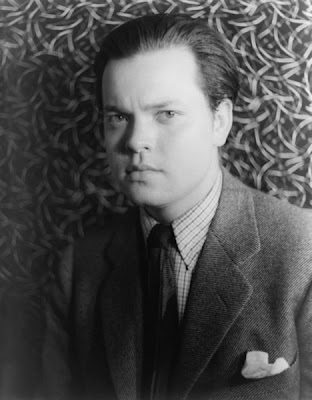
In 1936 a 21-year old Orson Welles directed a stage version of Shakespeare's Macbeth. The cast was all-black, and the setting was Haiti, not Scotland. It was mounted with money from the Federal Theater Project, which had helped set up black theater projects throughout the country. He got paid $50 a week, much less than what he got in his job as radio announcer. I'm going to borrow from the author and history professor Joshua Zeitz, who wrote an article about the production: "The cast and crew of Harlem's Macbeth were a diverse assemblage of experienced and inexperienced characters whose convergence on the Lafayette Theatre only contributed to the considerable amount of rumor swirling around the production. For the troupe's choreographer, Welles chose a a Sierra Leonean percussion expert. Asodata Dafora Horton, who coordinated the drumming and chanting that accompanied the drama, performed by dancers from the west coast of Africa. Their leader was a genuine witch ...

The Black Forties, Van Vechten Style

Image
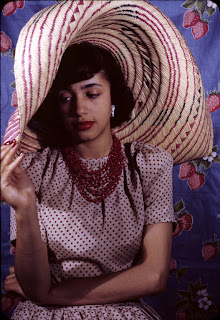
So I was tooling around looking for images to illustrate an article about Harlem, when I came upon a cache of stunning color photos, a few of which are shown here. These were all shot in New York City in 1940 and 1941: A socialite poses in an oversized hat. Youths hang out at a municipal pool in Harlem. As for the little boy, whose name is Julius Perkins, Jr., and about whom I can't find one bit of information (except that there is also a photo of him with, of all people, Tallulah Bankhead), he wears that scarf with such twenty-first century attitude that it's almost scary. Maybe Tallulah taught him how. You may recognize the photographer's style, but if you don't, the lensman was Carl Van Vechten , a white man whose portfolio of black people—particularly celebrities, literati, entertainers, famous folks and the like—is huge, and about whom I will be writing again. There is much to say about the strange man, not the least of which is that he wrote a book called Nigger ...