Posts

Showing posts with the label Slavery

Blacks in Manhattan: St. Augustine's Slave Gallery

It is a clear Sunday morning in the summer of 1828 and skiffs filled with people both black and white make their way across the East River from Brooklyn to lower Manhattan Island. The white people are churchgoers, on their way to services. The black men rowing them will also worship. The African-Americans guide the skiffs into slips and the white families disembark, making their way to Henry Street, where lies St. Augustine's, a brand-new Episcopal church. They take their places in the pews that fill the nave. Meanwhile the blacks climb up two treacherously narrow staircases to a pair of small rooms behind the pipe organ at the back of the church. It is dark and stiflingly hot where the Africans stand packed together. These rooms made up the church's slave gallery, one of two that remain in the United States today. (The other is in Boston's South Church.) For decades the church's staff and its parishioners knew what the spaces had been, but not until 1999 did they decid...

The More Things Change . . .

"Brutal subordination of the slaves was also a central tactic in controlling low-status whites who, if not thrown the bone of white supremacy, might have questioned the vastly unequal distribution of wealth and power among whites, which Southern grandees enjoyed and protected with guile and force." " . . . if threats, economic oppression, and political neutering didn't work, denial of education and brute force had to be used to reassure lower-class whites that their central psychological prop in a hardscrabble world—their superiority over black people in all realms of life—would be protected at all costs." Diane McWhorter in the foreward to Breach of Peace: Portraits of the 1961 Freedom Riders by Eric Etheridge

The Garden State Steps Up

Image
My home state of New Jersey apologized for slavery yesterday. I wasn’t going to blog about it until I read what a Republican assemblyman had to say about it according to the Associated Press: “But this was a sin that was atoned for in blood 150 years ago by the death of 650,000 Americans,” [Richard] Merkt R[epublican]-Morris [County] said, referring to the Civil War. “America does not and has never accepted the notion of collective guilt,” Merkt said. "We can all, and should all, express profound sorrow about the evils of slavery, but none of us can truly apologize for the institution because neither we nor anyone we represent was in any way responsible for it.” PLEASE! I’m so tired of that “our ancestors came here after slavery, we have nothing to do with that” mantra, I can’t tell you. TIRED. He couldn’t let his fellow legislators do a good thing, he just couldn’t. Here’s what I have to say to Assemblyman Merkt and all those other white folks who have the temerity to ask me “...

Reparations anyone?

Image
Reparations have not been on my mind lately, but I'm blogging on the subject now because the day fast approaches (October 10 th ) when an artist named Damali Ayo launches her National Day of Panhandling for Reparations. Whatever the arguments for or against reparations—and I'm of the belief that throwing money at a problem doesn't necessarily solve it—the woman has taken the rancor out of the debate by turning it into performance art. Her Web site describes the one-day event: "People of all races across the United States will sit outside of businesses, libraries, museums, art galleries, or on busy street corners. We will collect reparations from white Americans for the enslavement of Africans and African Americans. This money will be immediately paid out to black passersby. Both parties will be offered a receipt." I watched a video of her one-woman effort, and I laughed—it's really comical in its own way. I have thought about the idea of reparatio...

Slavery in Silhouette

Image
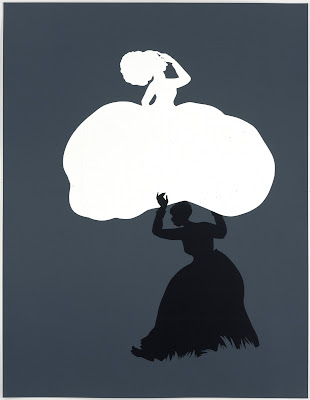
I’ ve been trying to find an excuse to write about the artist Kara Walker for some time. But because much of what I write here is New York-related, and there weren ’t any current exhibitions open, I’ v e held off. Today I have an excuse: Walker has opened a show, presented by no other than New York City Opera, a companion exhibition to the opera’s production of Margaret Garner, of which I wrote a few days ago. You may have seen Walker’s work: silhouettes created with all of the delicacy and grace of their eighteenth and nineteenth century counterparts. Then you look closer and you have to ask “what the . . .?” It’s sex and violence on the plantation. Her work has been called works of “imagined slave narratives” . I say “Imagined? Really?” I wouldn ’t be surprised if nearly everything in Walker’s images didn ’t happen at least once. If you look at the drama of the painting “The Modern Medea” by Thomas Satterwhite Nobles from last Tuesday's blog, you can see a kinship. My first ...

Another Kind of American Tragedy

Image
The Modern Medea by Thomas Satterwhite Nobles, 1867 It happened this way: One winter day in 1856, a group of slaves from Kentucky slipped away and made their way to the free state of Ohio. Some got safely away. A husband and wife, Robert and Margaret Garner, along with their four children, managed to get to the house of a formerly enslaved black man named Kite. But before they could get to Canada, the "Promised Land", slave catchers and police* surrounded, then stormed the house. The Garners and slavers fought room to room, and Robert shot one of them, a deputy marshal, in the process. When the slave catchers got to the room in which Margaret was cornered, a bloody sight met their eyes: Margaret had taken a knife and cut her toddler daughter's throat rather than, as she told it, allow her to be a slave again. She was preparing to kill all of her children, and then herself, when the posse burst in on her. The white world was shocked and horrified, as were, I'm sure, ...