Posts

A Noose Is a Noose Is a Noose
Image
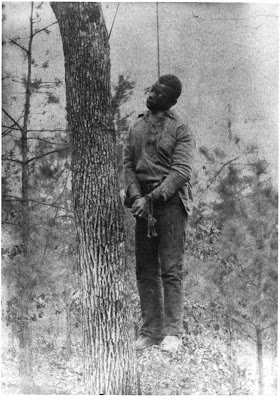
I’ve been down off my soapbox long enough I think. I’ve purposely not talked about the Jena Six case because I feel that it finally has enough media coverage.I'm not going to say anything that hasn't already been said, but I really wanted to go on record. Also, I think some folks are missing the point of it all. I don't believe that racial taunts should be met with violence. I do think that the administrators of the school* and local law enforcement should have done the right thing and thoroughly investigated and properly punished the white students who hung the nooses on the tree in the first place! I guess hope just always springs eternal with me. Instead, the students were suspended for a few days. They should have been expelled, thrown right out of that school and charged with a hate crime. They may be minors, but they're not children. That would have made it clear as day that that sort of behavior would not be tolerated. But they just slapped them on the wrist. I...
Slavery in Silhouette

Image
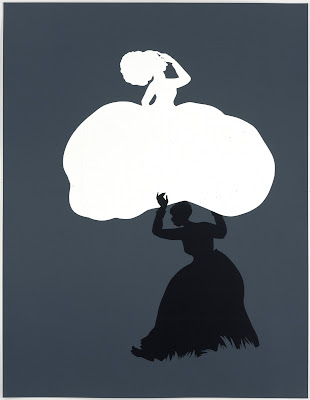
I’ ve been trying to find an excuse to write about the artist Kara Walker for some time. But because much of what I write here is New York-related, and there weren ’t any current exhibitions open, I’ v e held off. Today I have an excuse: Walker has opened a show, presented by no other than New York City Opera, a companion exhibition to the opera’s production of Margaret Garner, of which I wrote a few days ago. You may have seen Walker’s work: silhouettes created with all of the delicacy and grace of their eighteenth and nineteenth century counterparts. Then you look closer and you have to ask “what the . . .?” It’s sex and violence on the plantation. Her work has been called works of “imagined slave narratives” . I say “Imagined? Really?” I wouldn ’t be surprised if nearly everything in Walker’s images didn ’t happen at least once. If you look at the drama of the painting “The Modern Medea” by Thomas Satterwhite Nobles from last Tuesday's blog, you can see a kinship. My first ...

Another Kind of American Tragedy

Image
The Modern Medea by Thomas Satterwhite Nobles, 1867 It happened this way: One winter day in 1856, a group of slaves from Kentucky slipped away and made their way to the free state of Ohio. Some got safely away. A husband and wife, Robert and Margaret Garner, along with their four children, managed to get to the house of a formerly enslaved black man named Kite. But before they could get to Canada, the "Promised Land", slave catchers and police* surrounded, then stormed the house. The Garners and slavers fought room to room, and Robert shot one of them, a deputy marshal, in the process. When the slave catchers got to the room in which Margaret was cornered, a bloody sight met their eyes: Margaret had taken a knife and cut her toddler daughter's throat rather than, as she told it, allow her to be a slave again. She was preparing to kill all of her children, and then herself, when the posse burst in on her. The white world was shocked and horrified, as were, I'm sure, ...

Art Feeds the Soul

Image
As I was thinking about what I’d like to write about this week, each time an idea came up, it had to do with art. With all of the insanity swirling around us (melting ice caps, weather gone amok, conflicts everywhere—the entire koyaanisqatsi / naqoyqatsi enchilada— aaahh , look it up; you should know about these things), you might think art a frivolous thing to talk about. I say art is the only thing tha t has kept me, sometimes, from throwing up my hands and finally deciding that mankind is truly going to hell in a handcart. Angst essen Seele auf , (Fear Eat Up the Soul) as the filmmaker Werner Fassbinder so beautifully reminds us in the title of his 1974 film (queue it; it is so worth watching). Art feeds the soul. So I'm dedicating this week to art in Gotham City. In 1925 a man named William Nickerson founded Golden State Mutual Life , a black-owned company in a cubicle-sized office on Central Avenue in Los Angeles. There Nickerson and his team of dedicated agents set ou...

One For You. . . But None For You

I was walking down 14th Street and past a man who begs for money at the same spot every day. He is a white man, most likely in his twenties. He has long hair, a tattooed neck, is grimy, and I could pretty much bet any large amount of money that he is a junkie—mostly because I’ve seen him nodding off junkie-style, which is to say, while he’s in the middle of asking for change. I never give him money. Until a few days ago, that is. For whatever reason, I gave him a dollar. He was nodding off when I did it, so he didn’t see me put the money in his cup, which is maybe part of the reason why I gave it to him. Or was it? Did my conscience finally bother me enough? Because even though I don’t like to admit it, I have criteria for giving to panhandlers just as much as I do to any of the myriad charities who invade my mailbox on a near-daily basis (not to mention the ones who call all the time but hang up if they get the answering machine; note to those charities—I can’t help you if you don’t ...

I Don't Want Him, You Can Have Him . . .

Image
So, we're interrupting this regularly scheduled broadcast to have a little fun with history today. If my tone is kind of goofy and flip while I make my point, it is that sometimes I just have to not take things too seriously. So there’s an uproar about the Philadelphia Franklin Institute’s* King Tut Exhibit . Critics claim that the forensic reconstruction is inaccurate, not because of the young king’s features, but because his skin is white. I’m inclined to sigh and say “oh brother, here we go again—it’s just like when people start yelling about Cleopatra being a black woman. She wasn’t a black woman: According to all credible accounts, she was a Macedo nian Greek who became Queen of Egypt, which made her African by default. But at least once a year I get an e mail from someone flying off the handle because whatever latest incarnation of Cleopatra someone has put on the screen (the last one was in the HBO show Rome ) isn’t a brown/dark-skinned woman. She was not a black Af...

How To Sell Soul

So when Don Imus uttered those nasty words earlier this year on his radio show and all hell broke loose, suddenly we found ourselves leapfrogging past the discussion of whether what he said was wrong, illegal, or punishable. Suddenly black people found themselves in the uncomfortable position of having to defend their own use of the “n” word. A word white people created to describe us as the lowliest of the low, and one that, for better or worse has been appropriated by black culture. And now we’re told because we call each other that word, everyone is allowed to use it. I'll weigh in on the black use of the word in a future entry. But for now there is one hardcore rule that will never change. Read this carefully because I want you to be clear on how I stand on this: White people are never allowed to use that word in conversation, or out of historical context. Ever. Ever. Much of the finger pointing from mainstream society—and I say mainstream because many black peop...