Posts

Image
I present to you Illa Vincent, described in the Library of Congress’s online files as an “African-American wrestler,” although at the time this was published, 1910, he was most likely called Negro. I found this photograph while rooting around on the Library of Congress American Memory Web site. The photo may have been published in the Chicago Daily News , and the images (there are three or four others) reside with the Chicago Historical Society. I did a quick bit of research, on the Internet, and then over to the shelves for Arthur Ashe’s three-volume encyclopedia of black athletes called Hard Road to Glory ; neither yielded any information on this man. One day I’ll call the Historical Society; maybe an archivist will have something in her files. In the meantime Illa Vincent remains without a known story, and his image one of the many jewels of the Library of Congress.

“A thing is mighty big when time and distance cannot shrink it”—Zora Neale Hurston

Image
A Zangbeto at rest. Zangbeto are the Vodou guardians of the night among the Ogu or Egun people of Benin, Togo and Nigeria. They are charged with maintaining law and order, and keeping communities safe and secure.   In order for us to even begin to dismantle the artificial construct called race, and the racism against people of color that it serves, we need to decolonize our minds. And that begins with our origin stories. I'll let Djimon Hounsou speak in In Search of Voodoo: Roots to Heaven on YouTube movies or Amazon Prime . This is for folks who feel they'd like to begin decolonizing their minds.    Trigger Warning: There are scenes of animal sacrifice in this film. Bear in mind our own treatment of animals in the American agricultural industrial complex and how we benefit from it. Bear in mind that kosher and halal meat is prayed over by holy men to make it pure. Bear in mind that animal sacrifice is also part of the monotheistic (Judaic, Christian, Isla...

"Rushed Him to a Nearby Tree . . ."

Image
          I have been gone a long time from here, but it is time for me to come back. History can be a tool and knowledge IS power. The pen can be mightier than the sword—look how afraid some folks are of journalists and the media and education. This young man from my dad’s part of Alabama, with whom I share a last name, was also castrated, but the New York Times editors left that out. And I guess they thought they’d lighten the mood with the wacky story of the pie thief. But the assau lt, some will say. In the deep dark, waiting outside for his girlfriend to finish working as a maid for a white family in Eufaula, Ivor Peterson mistook a middle-aged white woman coming out of the house in which his girlfriend worked, and greeted her. The woman was startled, screamed like Amy Cooper in Central Park, the white men of the town chased Ivor down, and the rest is America’s unfortunate, shameful history. In 1911, Ivor Peterson—who may or may not have...

Black People with Banjos (and Fiddles and Guitars)

Image
Gotta write fast because I’m traveling to Savannah tomorrow, just enough time to tell you about the Carolina Chocolate Drops. Okay, so the name could be a bit minstrel-showish if you go there, but I ain’t goin’ there. The CCDs are reviving the black string band from back in the day, fiddles, banjos an all, and just listening to a couple of tunes has got me excited. If you like old timey type music, hit their site at myspace to listen to some samples ("Viper Mad" is already something I’m loving). For the full story, including how the banjo came from Africa, and how black people used to play stuff that sounds like something from the soundtrack to Deliverance, or O Brother Where Art Thou? read "Banjos, Kazoos, and Spoons, Oh My” at MSNBC.com. You can also get deeper African banjo history here . And there’s always video For Gothamites and surrounding tri-state denizens, the Chocolate Drops will be in New York, New York at Symphony Space on November 7. ...

"Pure Soul Excitement"

Image
This is a reposting from several years ago, hence the myspace references. Since then I have seen her in concert at the Bowery Ballroom, with Naomi Shelton & the Gospel Queens opening—they were both pure dynamite I promised you art last week, a big promise to make, and delivered three out of five days. So I have two to make up, and I will. But I had to take a break to talk about a soul sister. I first heard of Sharon Jones when I was listening to my eagerly-awaited Oxford American ’s annual music cd, which comes with their annual Southern music issue. The song on the cd was "How Long Do I Have to Wait for You?" and it was far and away the best cut on the cd. This was in 2006. I can’t remember why the editor-in-chief Marc Smirnoff and his colleagues included her, except that she was born in Augusta, Georgia, which technically make her a southerner. She moved to New York City, I’m presuming with her family, at an early age, so that makes her a New Yorker. At any rate, ...
To Alsana’s mind the real difference between people was not color. Nor did it lie in gender, faith, their relative ability to dance to a syncopated rhythm or open their fists to reveal a handful of gold coins. The real difference was far more fundamental. It was in the earth. It was in the sky. You could divide the whole of humanity into two distinct camps, as far as she was concerned, simply by asking them to complete a very simple questionnaire, of the kind you find in Woman’s Own on a Tuesday: (a) Are the skies you sleep under likely to open up for weeks on end? (b) Is the ground you walk on likely to tremble and split? (c) Is there a chance (and please check the box, no matter how small that chance seems) that the ominous mountain casting a midday shadow over your home might one day erupt with no rhyme or reason? Because if the answer is yes to one or all of these questions, then the life you lead is a midnight thing, always a hair’s breadth from the witching hour; it is vola...

It Was Only a Matter of Time

Image
This is a reposting from 2009, but in the wake of Ferguson, we need to be reminded that if this is how a black President was and is treated, how do we expect your average black person to be treated? There are some people who don't believe that they have to account to anyone for their actions. They walk this Earth believing they are superior, and they give themselves permission to do or say whatever they please. Joe Wilson claiming that his emotions during our President's address to Congress the other night got the better of him is correct; but it wasn't about healthcare. It's the fact that a black man is standing in a place he, Wilson, a white man, will never be. A black man is in a position of power, and contrary to what he and the rest of the racists in this country would like us to believe, he is an exceptional person. He may even be a great leader if he doesn't have to pause every time an idiot like Joe Wilson opens his mouth. He acted like a left-back fifth...

Raising a Ruckus on the First Day of BHM

Ruckus affray [ chiefly British ], broil , donnybrook , fracas , fray , free-for-all , melee ( also mêlée ), rough-and-tumble , row , brawl , ruction Related Words battle , clash , combat , conflict , contest , fisticuffs , handgrips , hassle , scrap , scrimmage , scuffle , skirmish , struggle , tussle ; horseplay , roughhousing ; altercation , argument , dispute , kickup , quarrel , spat , squabble , tiff , wrangle Poets (people I know David Winter, Elizabeth Hoover, Keisha-Gaye Anderson, Jennifer Milich—and people I don’t—Saeed Jones, e.e. cummings, Robert Hayden, Nikki G., June Jordan, on and on and on, and on and on and on) have been all up in my face lately, making me think, and I have to say I'm liking it. They should be all up in my face, my head, my brain, pulling me over and away from the foolishness set out there to distract me and “foolish me up,” drain me, keep me from creating and contributing and helping and living. Keep me from . What brought this on...

Intermezzo 2013

Image
For a few years I’ve been putting together something called Santa-dote—something that provides a bromide to overdosing on the holidays. But finding myself on Boxing Day with New Year's yet to come, I'm retitling this intermezzo, the sorbet served at a many-course meal to cleanse the palate. This year, I thought I’d share some of my favorite musical clips tied to film and television, from the Serpentine Dance (1902) filmed by pioneering woman filmmaker Alice Guy Blaché, one of the first directors of narrative fiction in film, to the soundtrack of the growing love and admiration between the main characters in Medicine for Melancholy (2008) Although Serpentine Dance is not a narrative, and there are other Serpentine dances by other women, attributed to other filmmakers, I chose this one because it’s a Blache. It is quite wonderful. Cab Calloway provides the awesome soundtrack to Max Fleischer’s brilliant animation in this clip “St. James Infirmary” from the 1933 S...

On a day in 1903 in New York City

Image
In May of 1903, five black entertainers assembled at the American Mutoscope and Biograph studio in New York City (the company, founded in 1895 was open until 1928. In 1991 the company was reincorporated in 1991) and performed two cake walks, which were recorded on film. Additional notes reveal the cake walks may have been performed on the roof of the studio. I found these two clips at the excellent Library of Congress online archive. The original description, d-word and all, goes like this: An amusing cake walk, by a company of New York darkies who excel in this line of work. Because others more knowledgeable than I am on the topic have written about cake walks, I'll direct you to their material. In short, the cake walk originated on plantations where enslaved blacks were given special dispensation to perform dances that mocked the master and missus. It was also performed by free blacks who needed no such permission. According to the essay "'Scuse Me While I Cake...

The Revolution WAS in Tribeca

Image
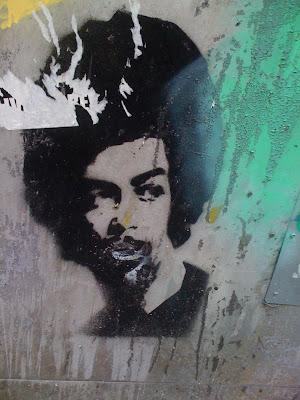
Gil Scott-Heron in Manhattan, 2012, from the cover of his 1971 studio debut album Pieces of a Man. Walking down Lispenard Street a week or so ago, enjoying the perfect blue-sky, just crisp September Sunday, I caught this portrait of Gil Scott-Heron. Wondered why the unknown artist who created the image chose that spot to showcase the man who told us the revolution will not be televised . The fact that the Arab Spring uprisings were not only televised but thrown worldwide on the Internet notwithstanding (and to be fair, Scott-Heron was making a different point, and a fresh one in 1970 on his live debut album Small Talk at 125th and Lenox ), there was no revolution, no uprising going on here in Tribeca yesterday. Just a steady stream of tourists buying knock-off designer purses and other goods and trinkets on Canal Street, a lot of sky-high real estate that the 99 percent can't afford, and aside from the denizens of Chinatown and the African street vendors on Broadway and Li...

A Different Legend of Sleepy Hollow

Image
For most of us the name Sleepy Hollow brings forth images from Washington Irving’s 1819 legend of the hapless schoolteacher Ichabod Crane, who is chased one night by a terrifying headless horseman and mysteriously disappears, never to be heard from again. But there is another picture of the Dutch enclave Irving lovingly paints, one of a bucolic place where life moves slowly and tradition holds sway: “I mention this peaceful spot with all possible laud,” writes Irving early in the story, “for it is in such little retired Dutch valleys, found here and there embosomed in the great State of New-York, that population, manners, and customs, remain fixed; while the great torrent of migration and improvement, which is making such incessant changes in other parts of this restless country, sweeps by them unobserved.” Situated on the east bank of the Hudson River about 25 miles north of New York City, today’s Sleepy Hollow has preserved, in the tradition of Irving’s embosomed hamlets, what...

I Left My Kindness in a Bus Shelter on Avenue A

Image
We all know someone like this. It’s the person you don’t want to stop and talk to when you see him or her on the street, yet has done nothing morally or ethically wrong to justify your ignoring that individual. It could be anybody, from any background, and the reasons for not wanting to spend any time with that person are varied: They invade your space when you talk. They are loud. They are terminally depressing. They are always on a soapbox. They tell the same story over and over again. They are hard to understand. They bore you to tears. They try your patience. Yet they are not bad people, and you feel they deserve your attention if they ask for it. In my case, it was a man who is mentally disabled in some way, and since I’m not a psychiatrist I wouldn’t begin to know how. He talks slow and with a slur. He shuffles when he walks. His movements are stiff. But he’s a decent fellow, as far as I know. When I see him, which is not often, I stop to chat for a moment or two. Not because...

The First Black Recording Artist

"Emerson needed more musicians, preferably cheap and loud. What about that middle-aged black man with the melodious whistle and hearty laugh he’d seen performing for coins at the Hudson River ferryboat terminal? Johnson listened to the proposition of the neatly dressed young man and said, “Why, sure . . . how much did you say you would pay?” “Twenty cents a song,” said Emerson, “and you can work all afternoon.” “Well, suh , just show me where you want me to go,” said Johnson, throwing in one of his hearty laughs for free. Emerson had his second recording artist." —From Lost Sounds: Blacks and the Birth of the Recording Industry, 1890-1919, by Tim Brooks. One could make a case that the American music industry was born when the inventor Thomas Edison first devised a way to record sound on tinfoil-coated cylinders in 1877, famously consigning his own voice to posterity (it should be noted that a somewhat newly discovered audio fragment of the French folk song “Au ...

Traces of the Trade--A Story of the Deep North

Image
“Dear kith and kin, I'm writing with information and invitations related to the documentary film project I have embarked upon about our mutual DeWolf ancestors and the slave trade.” From a letter by Katrina Browne to 200 family members and descendants of Rhode Island slave trader Mark Anthony DeWolf Although Traces of the Trade debuted in 2006, premiered at the Sundance Film Festival in last year, and aired on PBS's POV series , we never felt the noise around it was big enough. Over the past few years the North has had to take its sorrowful, yet rightful place as a key player in slavery in America (the New-York Historical Society's fantastic two-year exhibition “Slavery in New York” , brought  home the unalterable fact that New York City was a slave capital for two centuries). Still, we often look to the South.  We think that it can't be told enough, the story of how the American colonies, and then our entire nation was at one time or another completely ...